
Guide
Strength training and movement quality
Strength and movement belong together. Force without control is difficult to use, and mobility without strength can be hard to keep. These notes are general concepts, not a session plan with sets and loads.
Understanding strength training
Strength training is repeated practice against resistance, arranged so you can recover and, over time, progress. In general fitness the purpose is broader than appearance. People often use it to feel steadier when they lift, carry, climb, or get up from the floor.
Sessions can be short. The useful resistance is heavy enough to need your attention and light enough that the movement stays organised. The examples below illustrate ideas. They are not instructions written for your body.
Patterns that show up in daily movement
Most strength work, with or without equipment, returns to a handful of patterns. The name of a pattern covers many difficulties. Choose the version you can pause and resume with the same alignment.
-
01
Squat
Sitting and standing through a depth you can control. A chair can mark a target. It does not have to become a rule.
-
02
Hinge
Folding at the hips while the back stays organised, as you might when lifting a bag from the floor. Hands on the thighs can make the first version clearer.
-
03
Push
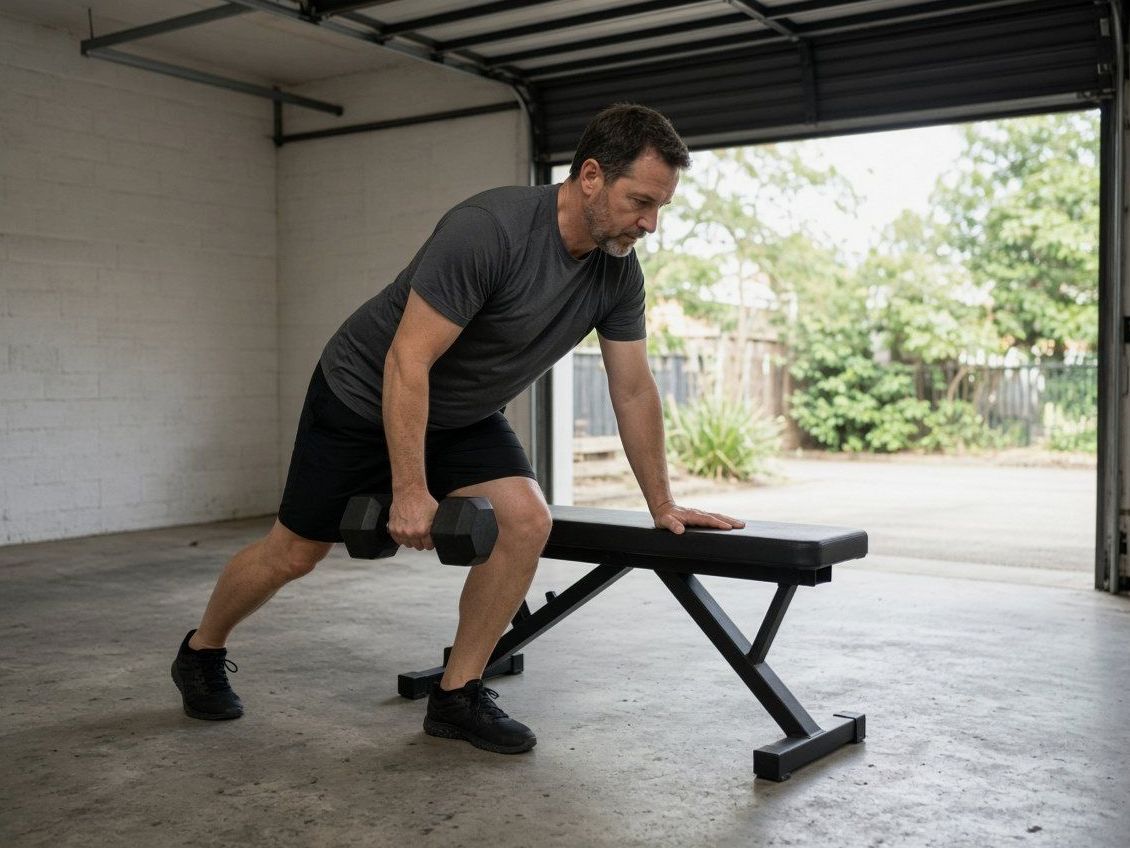
Pressing yourself or an object away. A wall, a sturdy bench, and the floor are related tasks of very different difficulty.
-
04
Pull
Drawing an object toward you, or drawing your body toward a stable support, when you have a setup that does not move.
-
05
Carry and step
Walking while holding a load, or stepping up onto a low, stable surface. These ask for balance as well as strength.
Bodyweight movements
Bodyweight training uses your own mass as the load. A squat to a comfortable depth, a hip hinge, a push-up against a wall or bench, and a supported row are common illustrations. A squat to a chair is not the same task as a deep unsupported squat, and either one may be the better choice on a given day.
If you cannot describe where your feet are and what your back is doing, the variation is too busy for now. Slow the movement down or choose a more supported version.
Resistance-based exercise
External resistance, such as dumbbells, kettlebells, or bands, lets you adjust the load more finely than bodyweight alone. A heavier object is not automatically better training. The useful load is one you can move through a controlled range for the repetitions you intended, with the last repetition still recognisable as the first.
Equipment is optional. Many people mix loaded and bodyweight patterns across the week, depending on what they can actually access.
Mobility and flexibility
Flexibility usually refers to how far a muscle or joint can move. Mobility adds control: you can enter and exit that range under your own strength. For general fitness, ankles, hips, and the upper back often matter because they show up in walking, squatting, and reaching.
A few slow repetitions, held only as long as you can breathe calmly, are enough to start. Forcing a stretch into pain is not a mobility method.
Balance and coordination
Balance is the ability to keep or regain your position over your feet. Coordination is the timing of that effort. Both can improve when you practise slightly unfamiliar but safe tasks: a slower step-up, a split stance, a weight carried in one hand, or standing on one leg beside a stable support.
Stay near something you can touch if your balance is uncertain. The aim is control, not a test.
Movement technique
Technique is the way you organise a repetition: where you place your feet, how you brace, how far you move, and how fast. A practical check is whether the first and last repetition still look related. Rushing, twisting to finish, or holding your breath until you feel dizzy are signs to reduce the difficulty. A camera is optional. Attention is not.
Gradual progression
Progress by small steps. Add a little load, or a repetition, or a little range, and leave the other variables alone. Stay with the new version until it feels repeatable. If a session costs you the next two days of normal movement, the step was too large, whatever a generic plan suggests.
Rest and recovery
Strength work creates a temporary stress. Recovery is the period in which you become able to do that work again at a similar or slightly better level. The window differs by person, sleep, and the difficulty of the session. Easier movement, such as walking, can sit alongside strength training.
Persistent pain, joint swelling, or numbness is a reason to stop and get advice from a qualified clinician, not a reason to hunt for a harder variation. The fitness fundamentals page discusses recovery in the same spirit, and healthy training habits covers how rest fits into a week.
Different ability levels
The same pattern can be made more supported or more demanding. A wall push-up, a bench push-up, and a floor push-up are related skills, not a moral ladder. Use the version that keeps you in a position you can hold. People who already train might progress by slowing the lowering phase or adding load. People who are new might progress by learning the positions first. Both are strength training.
Contact
Talk to Jarevi about this material
These pages are general education. If you want to ask about the site itself, the contact page has the Perth address, phone number, email, WhatsApp, and Viber details.